Stop the Boredom: How 10 Minutes of Hands-On Play Unlocks a Deep Connection to Nature
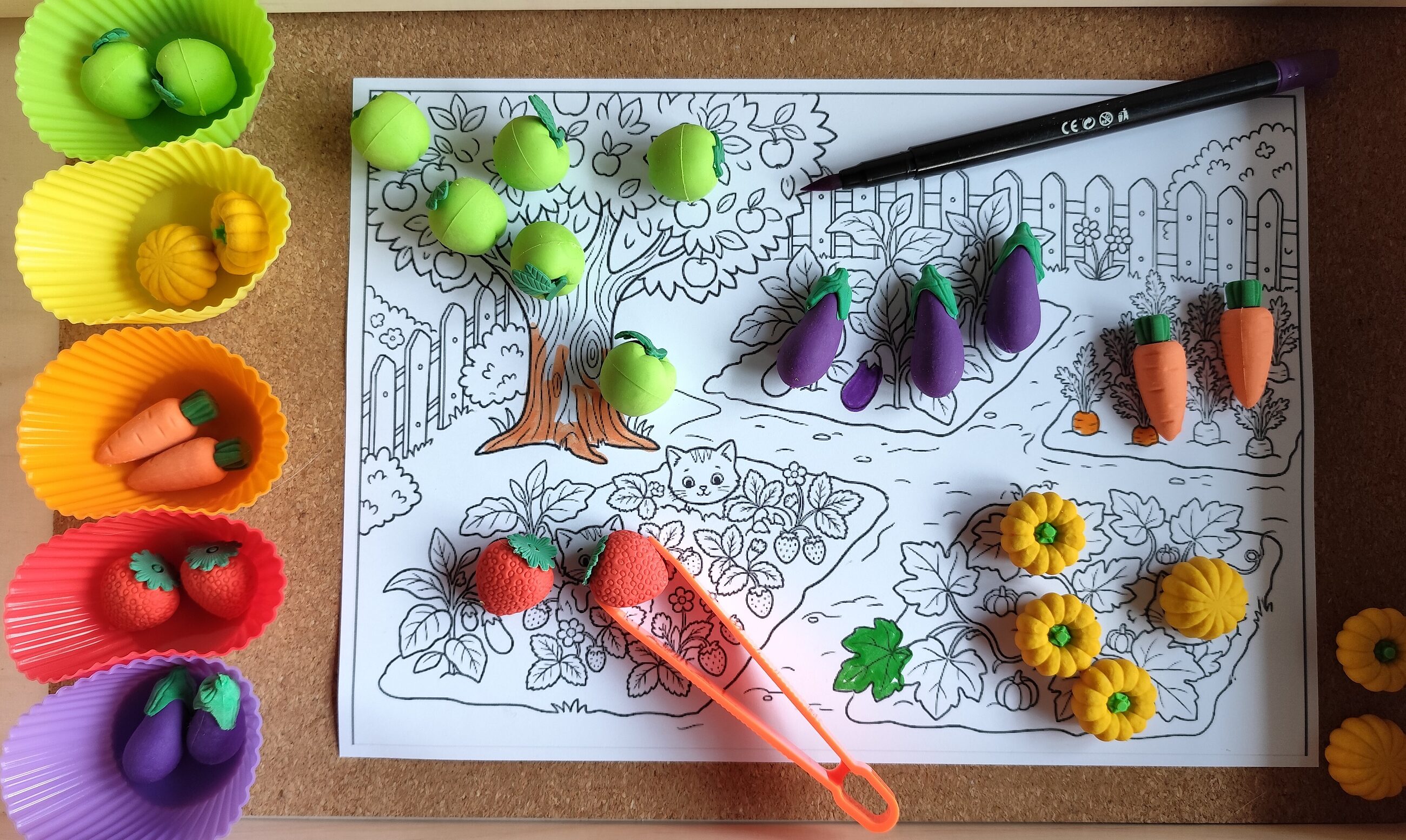
Let's be honest: Who wants to sit over tedious workbooks for hours? Not the kids, and certainly not us as educators and parents!
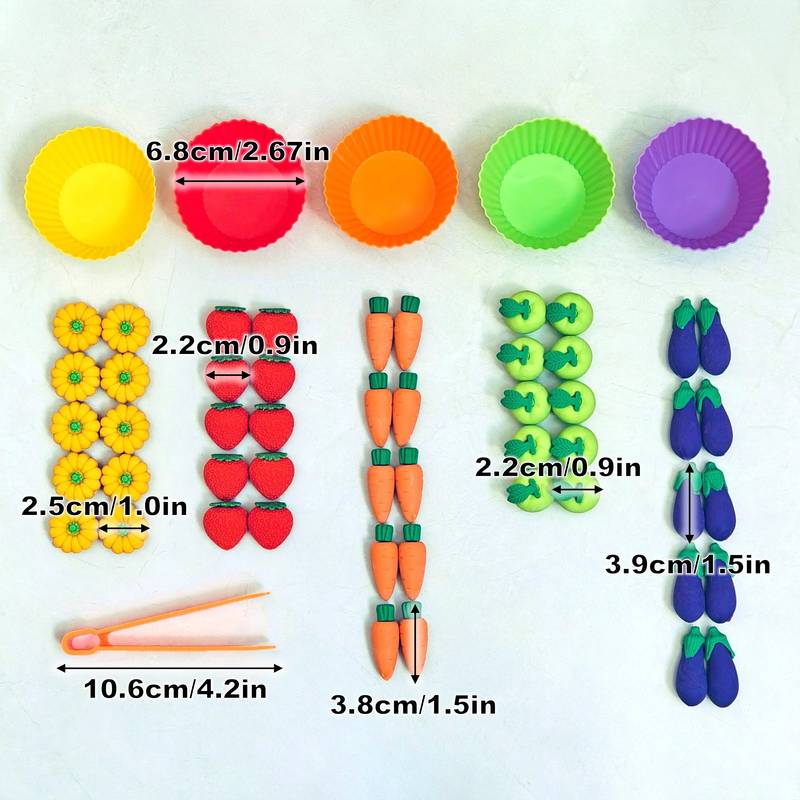
In my daily practice as an educator, my secret weapon has become a wonderfully compact resource—the Sensory Play & Learning Set from
Why Does It Work? (Reggio Emilia & Modern Pedagogy)
If you love the Reggio Emilia approach as much as I do, you already know its core belief: A child is not an empty vessel waiting to be filled, but an capable, curious researcher.
In this philosophy, the environment and learning materials serve as a provocation—an invitation to investigate. Instead of saying, "Today we are going to learn about vegetables," I place tweezers, mini fruit and veggie figures, and an activity sheet in front of a child and ask just one question: "What do you think is happening here?"
This simple set seamlessly combines three powerful educational frameworks:
Reggio Emilia: The child leads their own learning journey, solves problems, and expresses ideas through the "hundred languages" (storytelling, drawing, sorting, constructing).
Montessori: Builds fine motor precision (the pincer grasp), hand-eye coordination, focus, and independence.
STEAM (Science & Art): Merges natural science concepts (plant anatomy, growth, ecology) with early math (patterns, symmetry) and creative expression.
Who Is It For? (Ideal Age Group: 3–6 Years)
This age window is the golden era for sensory refinement and logical development:
Ages 3–4: Exploring textures, mastering tweezers, sorting vegetables by color, and expanding vocabulary with plant names.
Ages 5–6: Engaging logical thinking—extending patterns, exploring symmetry, investigating which vegetables grow underground (roots) vs. above ground, and tackling early environmental concepts.
Printable & Downloadable Activity Sheets for Your Lessons
Below are four free, printable activity sheets designed to be used alongside the sensory set:
1. Garden Architect (Spatial Planning & Composition)
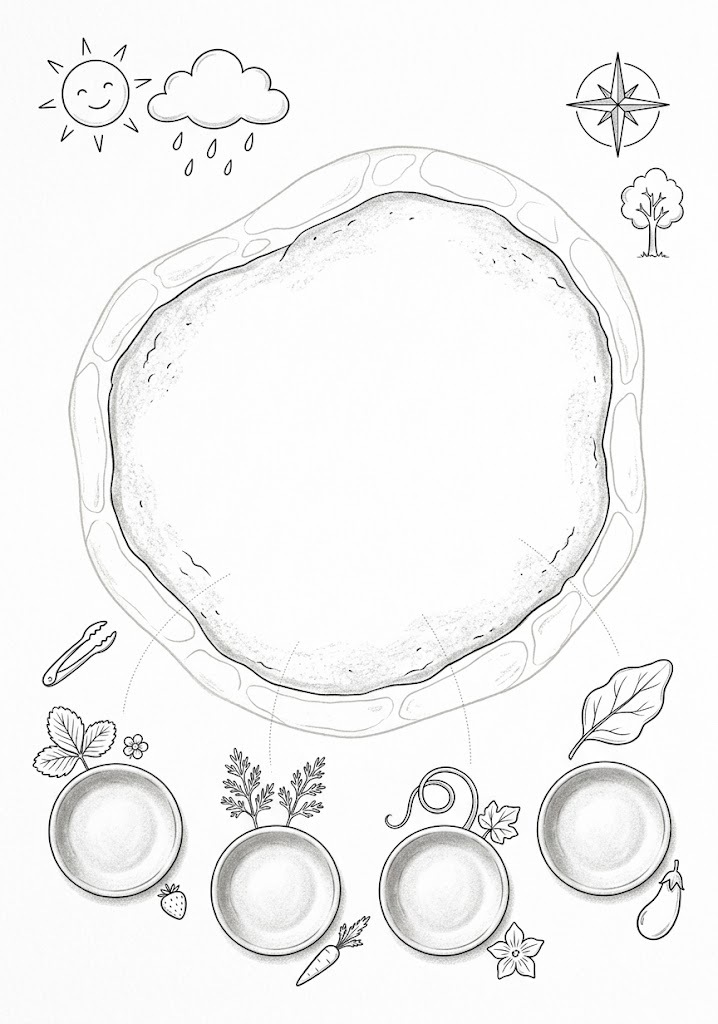
Concept: In the Reggio approach, the environment plays a central role. This sheet invites the child to become a landscape designer planning their garden. The page remains "incomplete" until the child places their figures onto it.
Visual Description: A large, open, organic garden bed bordered by a subtle stone or wood outline. In the top corner, a small sun and raincloud represent natural elements. At the bottom are four circular "palettes" featuring sketch cues (a strawberry leaf, a carrot top, a pumpkin flower, an eggplant leaf).
How to Use:
Sorting: The child sorts the figures onto the matching palettes at the bottom.
Planning: Using tweezers, they "plant" the figures into the main garden bed, arranging them in rows, circles, or freeform patterns.
Documenting: Once planted, the child can trace around the figures or draw roots and leaves, documenting their design on paper.
2. Researcher's Workbench (Light & Shadow Play)
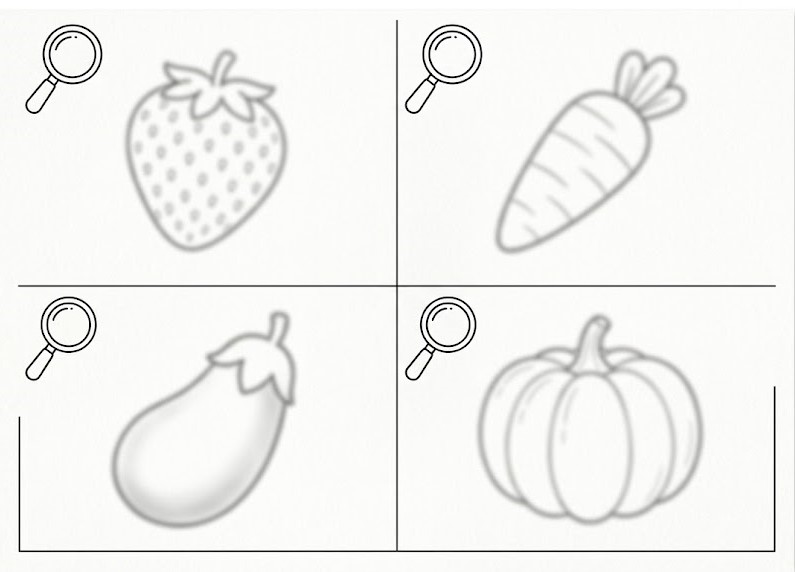
Concept: Inspired by Reggio light tables and mirrors, this activity focuses on form, shadow, and detail observation.
Visual Description: Divided into four equal quadrants, each featuring a stylized magnifying glass in the corner. Each quadrant displays a faint, subtle background pattern corresponding to an element:
Strawberry: Faint seed pattern.
Carrot: Soft horizontal texture lines.
Eggplant: Smooth, glossy contour.
Pumpkin: Soft radial segment lines.
How to Use:
Placement: The child places the corresponding figure over the faint outline.
Observation & Creativity: Prompted with "What else does this plant need?", the child draws missing details like stems, leaves, roots, or friendly garden bugs, or shades the negative space around the figures.
3. Nature's Pattern Lab (Minimalist & Language-Free)
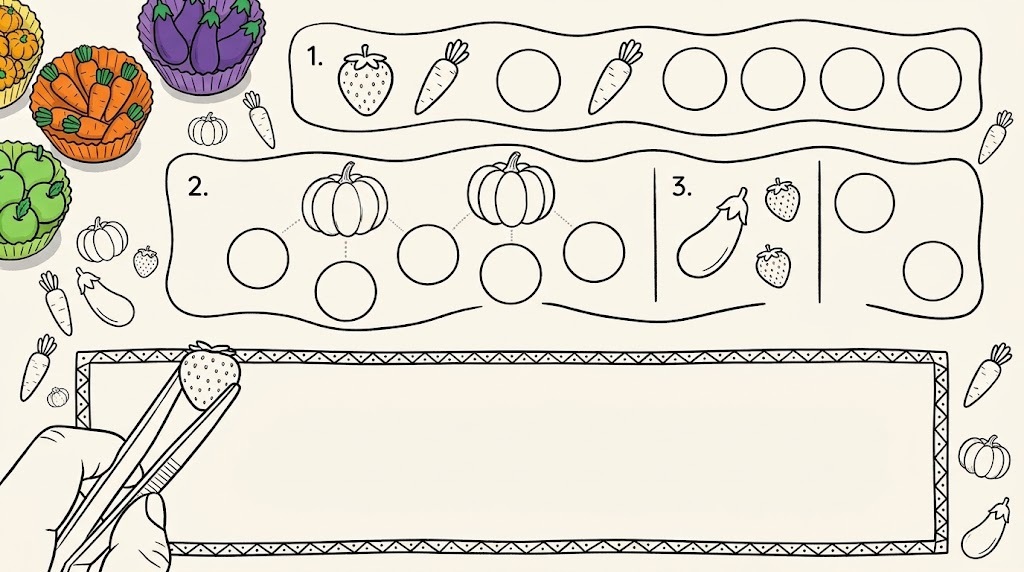
Concept: Blending early math and art, children explore natural patterns, rhythm, and symmetry. Designed without text (labeled simply with
1.,2., and3.) for universal, multi-language use.Visual Description: Three wavy, horizontal beds at the top:
Line 1 (Rhythm): Starts a pattern sequence (Strawberry - Carrot - [Blank] - Carrot - [Blank]...).
Line 2 (Grouping): Shows a "recipe" connecting a large pumpkin to three smaller blank circles.
Line 3 (Symmetry): A vertical dividing line with figures on one side and empty spaces on the other.
Bottom Area: A large open box for creative design.
How to Use:
Rhythm: The child completes the sequence using tweezers.
Grouping: They group one pumpkin with three smaller figures according to the recipe.
Symmetry: They mirror the composition on the opposite side of the line.
Free Creation: The open area lets them build their own unique mosaic or pattern.
4. Featured Mission: "Litter Detective & Pumpkin the Comedian"
Understanding emotions and caring for the environment are vital developmental milestones for young learners. This interactive story turns both into an exciting mission!
The Mission Story:
"Pumpkin the Comedian arrived in the garden today—he loves making jokes, but today he looks sad! Someone left plastic bottle caps and paper scraps among the strawberries and carrots. Pumpkin and his friends can't grow safely in a dirty garden!"
How to Play:
Emotion Recognition (Ages 3–4): The child sorts the figures between two states—"Happy Pumpkin" (a clean, watered garden) and "Sad Pumpkin" (a littered or dry garden).
Environmental Rescue (Ages 5–6): Using tweezers, the child acts as an "Environmental Detective," picking out foreign objects (like paper scraps or plastic caps) from the garden bed and sorting the veggies back into their matching silicone cups.
Reflective Discussion: Talk about why litter doesn't belong in nature and how small actions keep our planet clean and healthy.
Final Thoughts
Don't weigh yourself or your children down with overly complex lessons. Real learning happens through wonder, movement, and the joy of discovery. Give children the tools to explore, step back, and watch their minds flourish!
Ready to bring this approach into your classroom or home?
👉