Screen Time and Mobile Phone Use in Children Part 1 – Facts, Contradictions, and Expert Perspectives
Research for and against: how can we align technology with children’s development?
Over the coming month, we will introduce our readers to a series of articles for parents about screen time, smartphones, and children’s development in early childhood and primary school age.
Why are parents feeling so confused right now?
If there is a small person next to you who tries—quietly and almost unnoticed—to grab your phone, curl up in a comfortable corner, and start scrolling, chances are you have asked yourself at least once:
“When am I actually harming my child — by allowing phone use, or by restricting it?”
And just as likely, your social media feeds regularly throw at you a stream of contradictory statements, such as:
-
“Phones damage children’s brains, and the internet is addictive,”
-
“Without digital skills, children won’t be able to communicate with peers, fit in, compete, and will fall behind in the future.”
Interestingly, both of these statements are at the same time exaggerated — and partly true.
And that is exactly what makes this topic so complex.
In recent years, parents most often ask:
-
does early screen time harm a child’s brain development;
-
can phone use lead to addiction already in childhood;
-
will children who grow up without technology struggle to adapt to the modern world;
-
and — why do parents’ and experts’ opinions so often differ?
What do studies actually show about the impact of IT technologies on preschool and early primary school children?
Are we entering a new digital reality where those who adapt fastest will succeed — or are we moving toward a future with no real prospects, where we risk losing the most important thing of all: our humanity?
To answer these questions honestly, one thing must be said right away:
👉 there are no simple, black-and-white answers.
What we can do is look for a middle ground through a thoughtful, informed approach to technology.
And this is exactly what contemporary research shows.
“Screen time” — it turns out this term is far too simplistic
Not so long ago, the dominant idea was simple:
the more screen time, the worse the outcome.
However, over the past few years, a significant shift in thinking has taken place.
Researchers increasingly emphasize that the very term “screen time” is too broad and vague.
👉 It turns out that one hour spent in front of a screen can represent completely different experiences:
-
a child passively watching an endless stream of videos;
-
a child exploring a world map together with a parent;
-
a child programming a robot or drawing digitally;
-
a child playing a game that develops logic or cooperation skills.
This is precisely why the American Academy of Pediatrics (AAP) has moved away from strict time-based limits for older children and instead encourages parents to focus on content, context, and purpose, rather than the clock alone.
https://www.healthychildren.org/English/media/Pages/default.aspx
In other words, the key question is no longer “how long?”
but rather “how, why, and with whom?”

Where research does reach clear agreement
Although the overall picture is nuanced, there are areas where scientific findings are surprisingly consistent.
💤 Sleep – a quiet but extremely powerful factor
If there is one topic researchers rarely disagree on, it is sleep.
Interestingly, the problem is not the phone itself, but the moment when it should be turned off.
Screens used in the evening and in the bedroom:
-
shorten total sleep duration,
-
make sleep more superficial,
-
affect emotional regulation the following day.
Systematic studies show that children who have devices in their bedrooms are more likely to experience:
-
irritability,
-
difficulties with concentration,
-
increased impulsivity.
https://pubmed.ncbi.nlm.nih.gov/29367337/
According to the latest research and health organization guidelines, for preschool-aged children (approximately 2–5 years old), it is not recommended to use phones, tablets, or other screens at least one hour before bedtime. This helps improve sleep quality and makes it easier to fall asleep.
🧠 Why this matters
1. The effect of blue light
Light emitted by screens—especially in the blue spectrum—suppresses the production of melatonin, the hormone that signals to the body that it is time to prepare for sleep. This can delay falling asleep and reduce sleep depth.
https://pmc.ncbi.nlm.nih.gov/articles/PMC6295443/
https://pmc.ncbi.nlm.nih.gov/articles/PMC8933063/
https://www.sleepfoundation.org/children-and-sleep/how-blue-light-affects-kids-sleep
2. Brain stimulation
Engaging with active content (games, videos) in the evening stimulates attention and the nervous system, making it difficult for the brain to “switch off” before bedtime.
https://www.kidshealth.org.nz/screen-time-sleep
https://pmc.ncbi.nlm.nih.gov/articles/PMC5839336/
Technology itself is not “bad” — but sleep is a foundation of healthy development, and it is easily disrupted.
👀 Vision – a fact that is often overlooked
This topic is discussed less frequently, yet the research findings are very clear.
A large meta-analysis published in 2025 shows that
each additional hour of daily screen time increases the risk of myopia (nearsightedness), while time spent outdoors in daylight significantly reduces this risk.
https://jamanetwork.com/journals/jamanetworkopen/fullarticle/2822344

Does screen use displace essential elements of a child’s daily life?
Yes — if screen use is excessive, passive, or of low quality.
In research, this is referred to as the displacement effect — a situation in which screen use replaces experiences that are essential for a child’s development.
What does screen use most often displace in preschool age?
1. Free, unstructured play
In developmental psychology, free play is considered a foundation for:
-
imagination development
-
problem-solving skills
-
self-regulation and creative thinking
Screen content is already fully constructed for the child — there is no need to invent a storyline, roles, or solutions.
When screens systematically replace free play, opportunities to practice creativity and cognitive flexibility are reduced.
Sources:
https://www.aap.org/en/patient-care/media-and-children/
https://pmc.ncbi.nlm.nih.gov/articles/PMC6469753/
2. Movement and embodied experience
Research shows a link between increased screen time and:
-
lower levels of physical activity
-
weaker gross and fine motor skills
-
less developed body awareness
In preschool age, brain development is closely tied to movement — children think through their bodies.
Prolonged sitting in front of screens reduces these crucial experiences.
Sources:
https://www.who.int/publications/i/item/9789241550536
https://bmcpublichealth.biomedcentral.com/articles/10.1186/s12889-017-3955-8
3. Live social interaction
The development of language, empathy, and social understanding occurs through:
-
dialogue
-
eye contact
-
spontaneous, unpredictable interactions
Passive screen use does not provide the kind of feedback a real person does and may reduce the time children spend in conversations with adults or peers.
Sources:
https://jamanetwork.com/journals/jamapediatrics/fullarticle/2669722
https://pmc.ncbi.nlm.nih.gov/articles/PMC5823000/
Can screens also have a positive contribution?
Yes — under specific conditions.
Research does not claim that screens are always harmful; rather, it emphasizes that benefits are possible only when certain conditions are met.
1. When content is high-quality, age-appropriate, and meaningful
Digital environments can quickly capture interest through engaging, educational content — with opportunities to analyze, compare, and draw conclusions. This can:
-
broaden a child’s understanding of the world
-
introduce natural, cultural, and social processes and motivate real-life exploration of what is seen on screen
-
spark curiosity and questions about the surrounding world
However, studies emphasize that the benefit is limited — screen experiences cannot replace real-life learning if no follow-up action occurs.
Sources:
https://www.ncbi.nlm.nih.gov/pmc/articles/PMC6723268/
https://www.commonsensemedia.org/research
2. When screen use is shared with an adult (co-viewing)
One of the strongest positive factors identified in research is adult involvement.
When an adult:
-
comments on what is being watched
-
asks questions
-
connects on-screen content to real-life experiences
the child learns to analyze rather than simply consume information.
Sources:
https://pmc.ncbi.nlm.nih.gov/articles/PMC6843420/
https://www.aap.org/en/news-room/news-releases/aap/2016/american-academy-of-pediatrics-announces-new-recommendations-for-childrens-media-use/
3. When screens inspire activities beyond the screen
In positive scenarios, screens act as a starting impulse:
-
a video about animals → play, drawing, questions
-
a story → role-play
-
a simple experiment → trying it out in real life
In these cases, the screen is not the end point, but the initial spark.
Source:
https://www.frontiersin.org/articles/10.3389/fpsyg.2018.01839/full
Critical thinking in preschool age
Research clearly shows that
critical thinking in preschool age is still in the process of development.
Children at this stage:
-
are not able to independently evaluate the credibility of information,
-
cannot distinguish advertising from factual content,
-
tend to interpret content literally.
For this reason, experts emphasize that critical thinking does not emerge from the screen itself, but from conversations about what is seen.
Sources:
https://www.ncbi.nlm.nih.gov/pmc/articles/PMC7602468/
https://www.unicef.org/globalinsight/media/children-and-media
Mental health: surprisingly nuanced findings
Media headlines often claim that screen time “causes depression and anxiety.”
However, when we look more closely at scientific research, the picture becomes far more complex.
The UNICEF Innocenti 2025 report indicates that
there is no convincing evidence that screen time itself directly causes mental health disorders.
👉 Instead, higher risk is associated with:
-
uncontrolled, compulsive use,
-
social comparison mechanisms on social media,
-
cyberbullying,
-
lack of sleep,
-
emotional loneliness.
https://www.unicef.org/innocenti/reports/childhood-digital-world
In other words, technology amplifies the quality of existing environments and relationships rather than acting in isolation.
Young children and technology: what researchers are truly concerned about
The World Health Organization (WHO) is very clear on one point:
in early childhood, the most essential experiences are live, embodied ones — movement, play, touch, conversation, eye contact.
https://www.who.int/publications/i/item/9789241550536
Interestingly, researchers are not primarily worried that children will “learn how to press buttons,”
but rather that screens may replace relationships.
A child can be technically very skilled, yet still lack:
-
emotional regulation,
-
social experience,
-
critical thinking.
But can technology also support development?
Yes — and this is where another important shift appears.
Research on computational thinking, basic programming, and creative digital activities shows that children can:
-
analyze relationships,
-
understand cause-and-effect patterns,
-
practice problem-solving,
-
develop creativity,
when technology is used as a tool — not as a babysitter.
https://www.frontiersin.org/articles/10.3389/feduc.2020.574915/full
Screens as a language of social belonging
Researchers increasingly use the term “shared digital culture.”
This refers to:
-
shared movies, series, and characters,
-
gaming experiences,
-
jokes, phrases, and references,
-
a common “language” that helps children integrate into peer groups.
📌 A child who is unfamiliar with this culture may find themselves excluded from conversations.
Sources:
https://journals.sagepub.com/doi/10.1177/2056305118768300
https://www.unicef.org/globalinsight/media/digital-culture-and-childhood
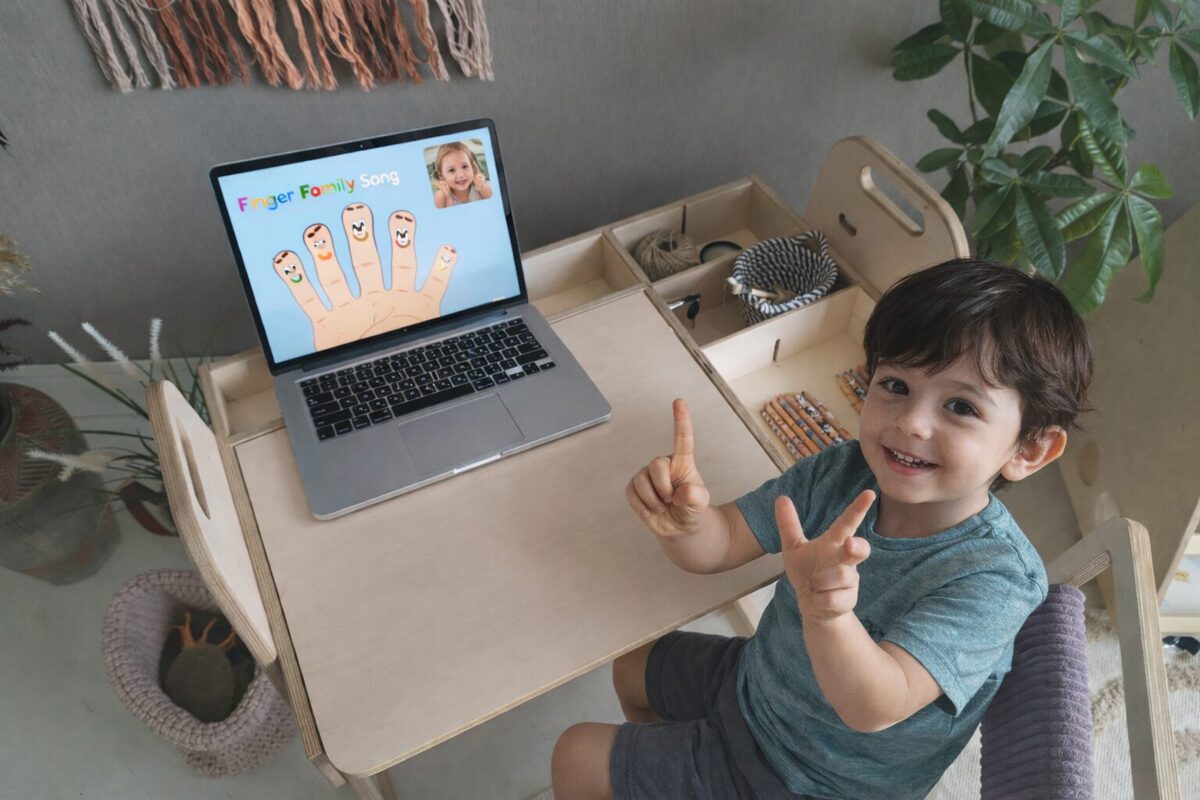
“If you don’t know this, you’re not one of us”
Studies on social inclusion in preschool and early school environments have found that:
-
children use media content as a social bridge,
-
shared interests foster a sense of belonging,
-
children who cannot participate in these conversations are more often ignored or excluded.
This is not theoretical — it has been empirically observed.
Sources:
https://www.sciencedirect.com/science/article/pii/S0747563217303841
https://www.tandfonline.com/doi/full/10.1080/17482798.2019.1641133
Social isolation and aggression
Unfortunately, research data show that children who are completely denied access to screens and online socialization often face a higher risk of aggression and social exclusion.
Studies have found that:
-
children who are unfamiliar with their peers’ shared culture may become:
-
targets of ridicule,
-
socially isolated,
-
perceived as “strange” or “different” within the group.
-
Importantly, this is not because the child is “worse” or less capable, but because they:
-
cannot recognize shared references,
-
do not understand group dynamics,
-
are unable to participate in shared play or conversations.
Sources:
https://www.ncbi.nlm.nih.gov/pmc/articles/PMC7025730/
https://www.childtrends.org/publications/digital-media-peer-relations
Online games as a space for socialization
Contrary to a common myth, research shows that:
-
many games promote cooperation rather than isolation,
-
children develop:
-
rule-following skills,
-
role distribution and teamwork,
-
conflict resolution,
-
conversational communication.
-
Especially in terms of language learning:
-
children actively use a foreign language rather than learning it abstractly,
-
everyday conversational language develops, not only academic vocabulary.
Sources:
https://www.frontiersin.org/articles/10.3389/fpsyg.2019.01221/full
https://www.cambridge.org/core/journals/language-learning-and-technology/article/online-games-and-language-learning
Parent-controlled information environments — a hidden risk?
Research also includes criticism of complete information filtering imposed by adults.
If a child:
-
is only allowed access to content selected by parents,
-
is not introduced to peer culture,
➡️ this may:
-
hinder the development of autonomy,
-
increase feelings of alienation,
-
create tension and conflict between children and parents later in life.
Sources:
https://journals.sagepub.com/doi/10.1177/1461444820924824
https://www.unicef.org/parenting/child-development/digital-world
Summary: so how does it really stand?
-
A phone in itself is neither good nor bad.
-
What is risky is uncritical, lonely, and uncontrolled use.
-
Environment, relationships, and adult presence are decisive factors.
-
Technology can both hinder and support development — depending on how it is introduced into a child’s life.
What’s next?
In the next article, we will explore what future developmental needs children may face in a world shaped by IT technologies — and what is required to help a young person engage with this world confidently and safely, without causing harm to themselves.
We will look at how to practically create environments in which children can grow alongside technology, rather than in its shadow —
how to balance safety, freedom, creativity, and real-world experience.
If you have questions or ideas, feel free to leave a comment or write to
📩 [email protected]
Edda Borde, MSc in Social Psychology, author of the article,
will be happy to engage in conversation.
If you found this article useful, please share it on social media,
so this discussion can become deeper and more meaningful.