Waldorf Dolls – More Than a Toy: Why They Become a Child’s Most Meaningful Companion
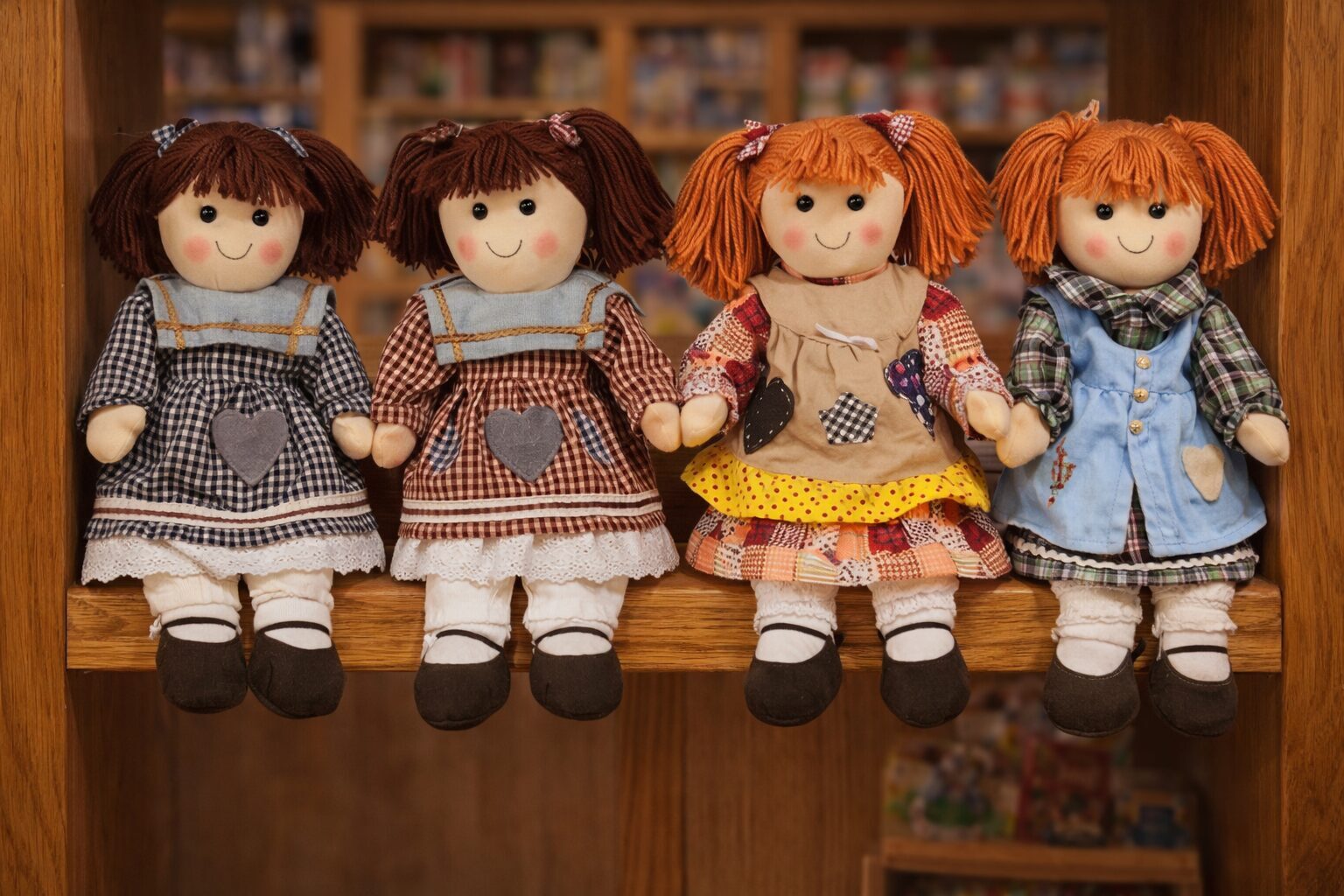
In today’s toy world—full of flashing lights, sounds, and smart technology—Waldorf dolls can seem almost too simple.
And yet, it is exactly this simplicity that makes them so powerful.
What is a Waldorf doll, really? Why do experts recommend choosing one? Will your child even like it—or would a Barbie be a safer bet? Do children today even want to play with soft, handmade dolls?
The answer is yes. And often, they love them far more than we expect.
Author: Edda Borde, Mg. psych. soc.
What is a Waldorf doll?
Waldorf dolls are rooted in Waldorf education, a philosophy that supports a child’s natural, balanced development. They are made from natural materials—such as cotton and wool—and have intentionally simple facial features.
This simplicity is not accidental.
Research in developmental psychology shows that toys with fewer defined features encourage higher levels of creative thinking. For example, a 2020 study in the Journal of Early Childhood Research found that children engage in longer, more focused play and create more original scenarios when playing with “open-ended” toys.
In simple terms: the less the toy “tells,” the more the child creates.
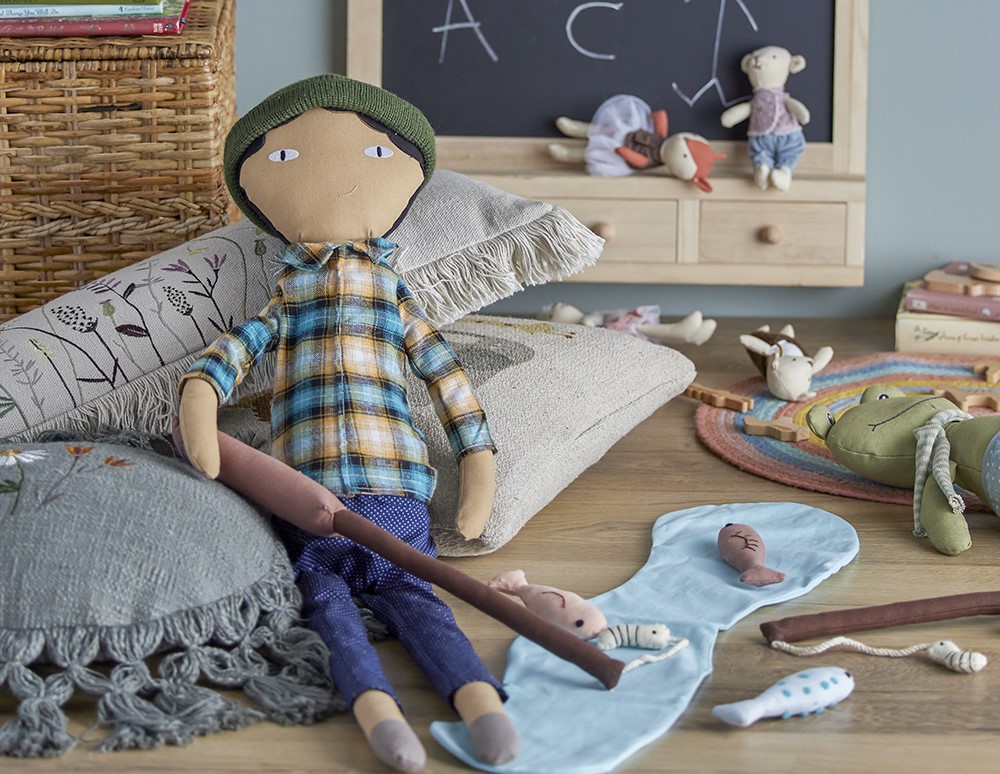
Why do children love them?
Children do not always choose what is the loudest or most visually stimulating. In fact, very realistic dolls can sometimes feel unsettling to young children. This relates to what psychologists call the “uncanny valley” phenomenon—the discomfort we feel when something looks almost human, but not quite.
Research suggests that even children can sense this mismatch. Highly realistic dolls with fixed expressions may feel emotionally “off,” making them harder to connect with.
Waldorf dolls are different.
Because their expressions are neutral, children can project their own emotions onto them:
- “Today my doll is happy.”
- “Now she feels tired.”
- “Maybe she is sad.”
This flexibility supports:
- emotional intelligence,
- empathy,
- and a deeper sense of connection.
Neuroscience research, including work from the Harvard Center on the Developing Child, highlights that free play is one of the key foundations for emotional regulation and healthy relationship-building later in life.
Care, responsibility, and deeper values
There is another layer to this conversation—one we do not always speak about openly.
In today’s fast-paced world, there is a growing narrative that children “take up our time.” That they interfere with productivity, careers, or personal freedom.
And yet, most parents know something very different:
children are what give our time meaning.
The ability to care, to give, and to love is not something children learn from lectures. They learn it through play.
When a child cares for a doll—dressing it, feeding it, comforting it—they are practicing:
- the ability to love and share,
- a sense of responsibility,
- care for another being,
- the ability to see from someone else’s perspective.
Long-term studies, such as the Dunedin Study in New Zealand, show that early development of self-regulation and empathy strongly predicts better outcomes in adulthood—both in relationships and in work life.
Social psychology research also suggests that when care and responsibility are not experienced as values in childhood, they are less likely to become part of adult life.
Play is not “just play.”
It is a language of values.
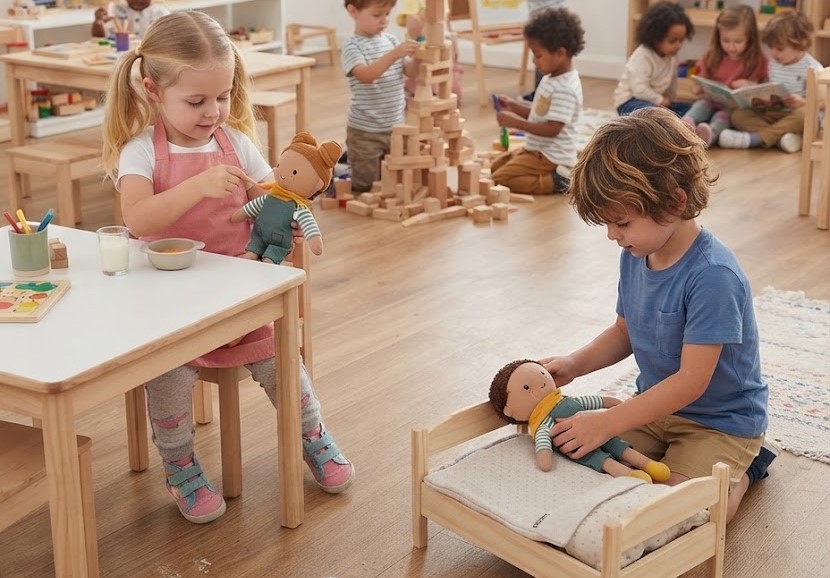
3 simple ways to play with a Waldorf doll
Start by giving the doll a name. Children experience great joy when their parents respect their toy as something meaningful and call it by name too. Choosing a name can become a special shared moment.
You might read together and let your child choose a name inspired by beloved English-language children’s books:
- Alice's Adventures in Wonderland – Alice
- Madeline – Madeline
- The Snowy Day – Peter
- Winnie-the-Pooh – Christopher Robin
- Anne of Green Gables – Anne
Or choose simple, timeless names that do not impose a fixed story:
Anna, Lily, Emma, Jack, Oliver, Theo.
This allows the child to create their own narrative rather than repeat an existing one.
1. “The World Wakes Up” (rhythm and safety play)
This is not just “playing house.” It is experiencing the rhythm of a day as a story.
The child:
- wakes the doll,
- dresses it according to the weather,
- prepares the day—meals, walks, evening rest.
A parent might gently say:
“Morning is here… what will your doll do today?”
What it develops:
Research shows that predictable rhythms support a child’s sense of safety and help regulate the nervous system.
Here, the child is not just repeating a routine—they are internalizing it.
2. “When the World Feels Too Much” (emotional integration play)
In Waldorf-inspired play, emotions are not explained—they are experienced.
The doll may:
- feel confused,
- sad,
- overwhelmed.
The child creates a response:
- a blanket,
- a small “home,”
- quiet presence.
The parent does not lead, but accompanies:
“I see your doll is having a hard day.”
What it develops:
This is known as projection play—children transfer their inner experiences onto an object.
Research shows this supports emotional regulation and empathy, especially in early childhood.
Here, the child learns: emotions do not need to be suppressed—they can be felt and transformed.
3. “The Little Caregiver” (responsibility and meaning)
This is one of the most powerful aspects of Waldorf play.
The doll is “smaller,” “weaker,” in need of care.
The child steps into a caregiving role—not as imitation, but as a lived experience.
A parent might gently suggest:
“Your doll needs you.”
What it develops:
Long-term studies show that early experiences of responsibility, care, and self-regulation are strongly linked to stable relationships and successful adult functioning.
Here, a deep internal message forms:
“I care, therefore I matter.”
Why this approach matters
Today we often hear:
“I don’t have time for children.”
But psychologically, the reality is different:
Children are not time consumers.
They are what give time meaning.
And children do not learn this from instruction, but from experience:
- that relationships matter,
- that care is valuable,
- that presence is meaningful.
If this is not experienced in childhood, it often does not naturally emerge in adulthood—not because people do not want it, but because it is not part of their inner model.
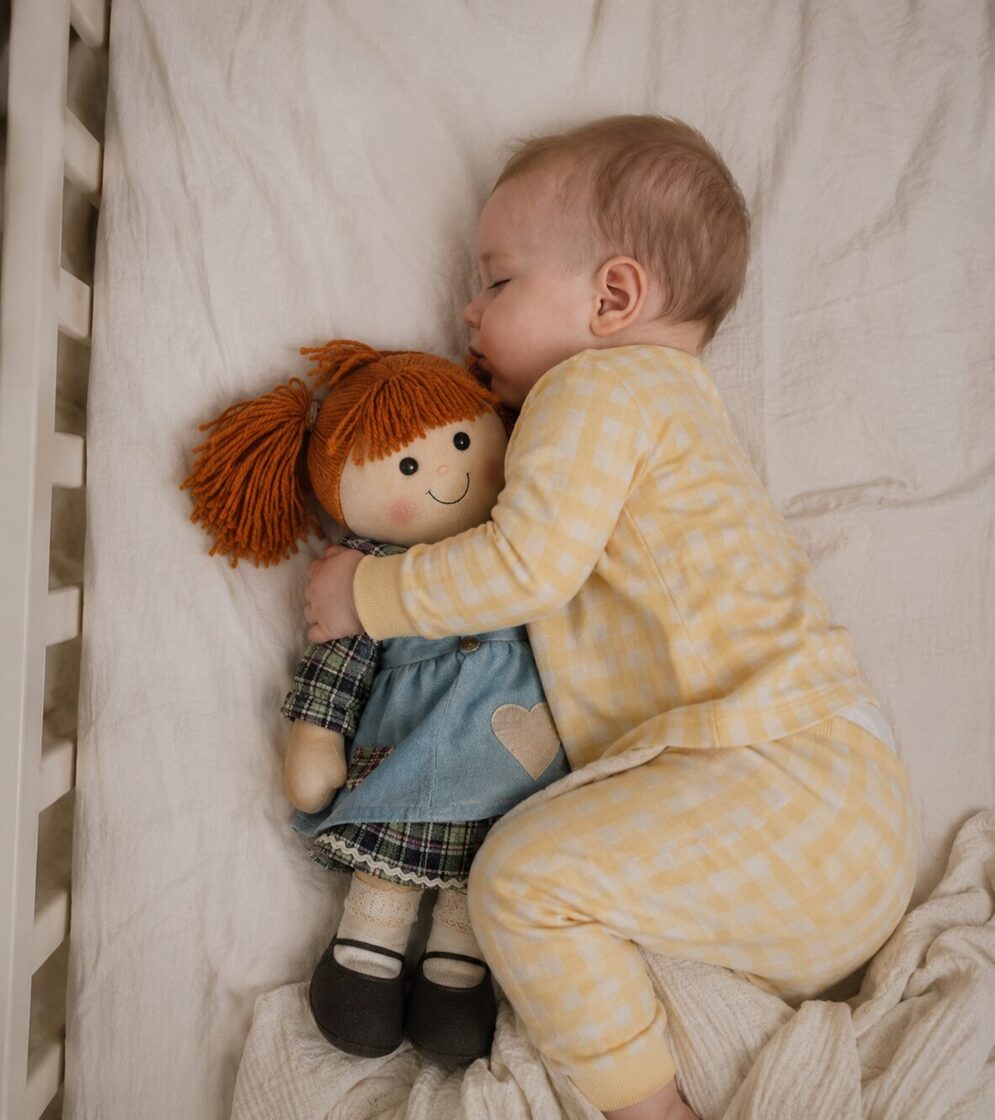
In conclusion
A Waldorf doll is not a toy that entertains a child instead of us.
It is a toy that invites the child into life.
It teaches love, presence, and relationship. It helps a child understand that being with another is not a waste of time—it is what gives time its value.
And perhaps that is exactly what many of us are searching for today.